
Sizing an Outboard Motor for a Small Yacht
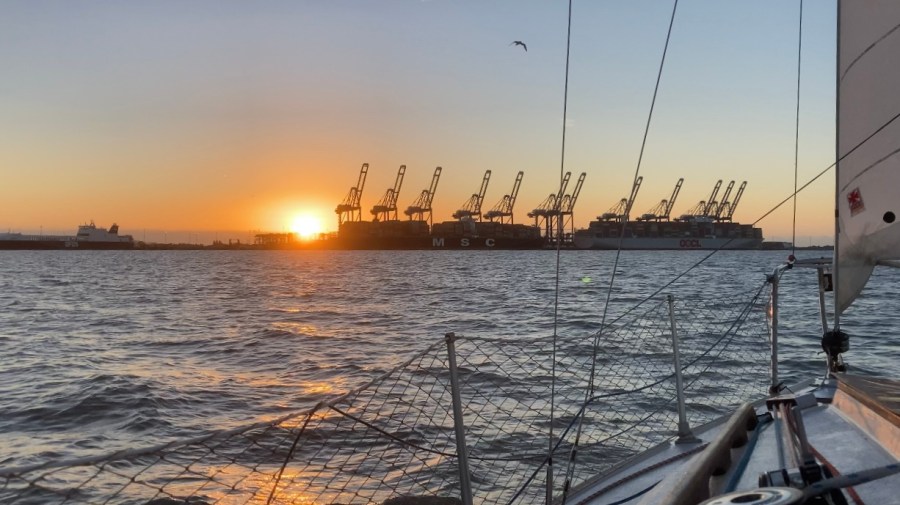
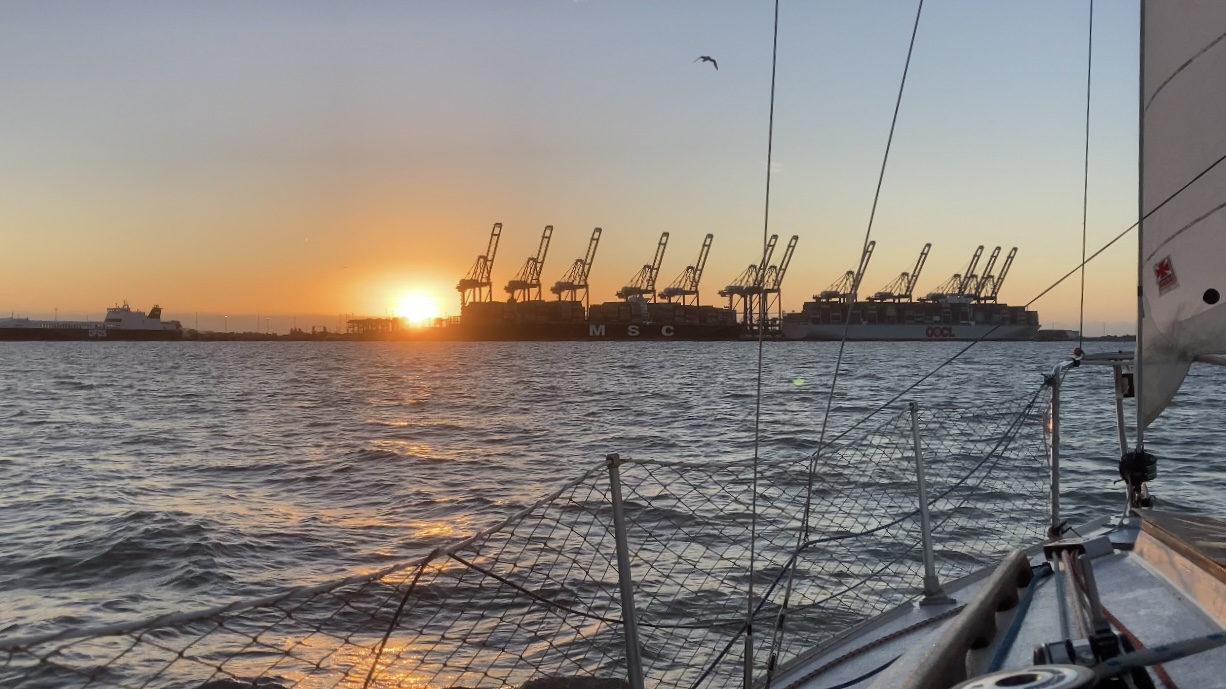
I am frequently asked what size outboard motor would suit a small yacht/trailer sailer, and more specifically, suited for cruising the estuaries on the East Coast of England. The East Coast certainly has some amazing estuaries offering magnificent sunsets, wildlife and isolation. It also has its fair share of turbulent entrances with sand bars that are constantly on the move.
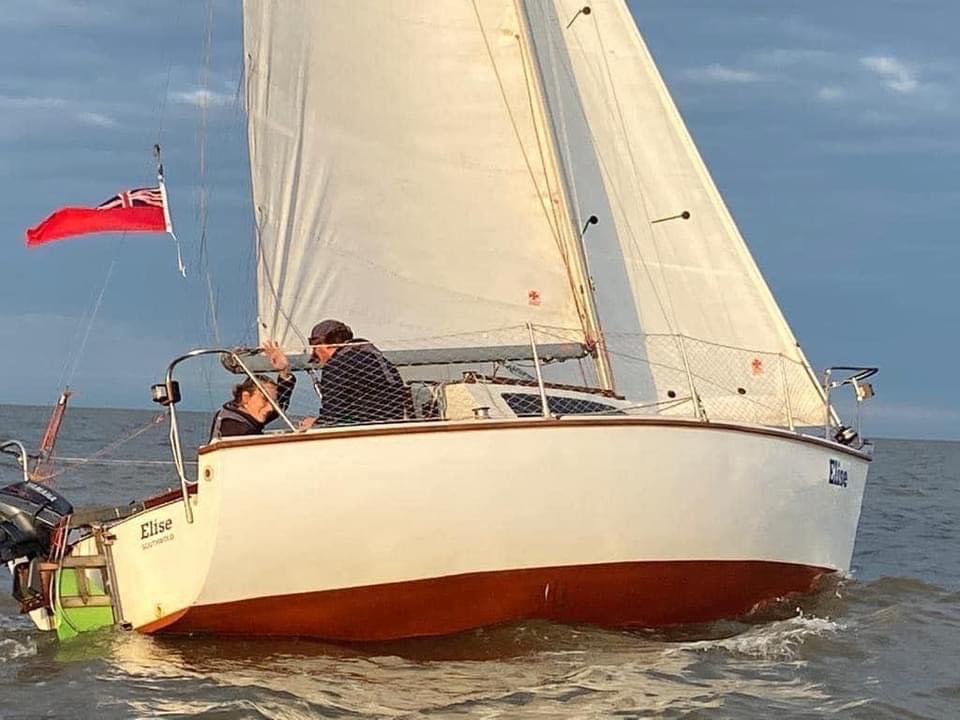
So, I thought I’d share my experiences of different outboards for my 20 foot trailer sailer specifically. Hopefully, by the time you have read this post, you will be able to consider your needs and have an idea of what outboard motor you maybe looking for.
This article is certainly not a buying guide, bit simply sharing my experience of what works really well in fast flowing estuaries and how I achieved the ultimate combo.
Considerations
Firstly let’s look at the considerations worth thinking about when mulling over engine comparability.
- Size/weight of vessel
- Sailing area
- Theoretical maximum hull speed
- Power to weight ratio
- Economy
You would have thought 2 stroke/4 stroke will appear here but they will be discussed in depth.
Size/weight of vessel
Obviously the first thing to consider is the size and weight of your vessel. Let’s reference my situation throughout as a base line. So my Copland Harrier 20 is 20 feet/6.1m long and has a displacement weight of 907kgs. Let’s say 1000kgs for arguments sake. Some boats are smaller and heavier, some are larger and lighter and vice Versa right? But lets just build a picture.
Sailing area
Depending on where you sail and what situations you see yourself getting into, will help determine your needs. For example, if you sail on non tidal waters you may be able to consider electric propulsion. If sailing on the south coast you may only need something to boost you out of a marina perhaps, it’s not my sailing area so I’m no expert there but you get the point. Local knowledge or an almanac will help determine tidal flows and port entrances e.t..
For me, it’s the east coast of England where I sail and where most of the estuaries are fast flowing especially on an ebb tide. Tidal flows can be up to 6 knots. Some, if not most entrances can get pretty hairy especially with any strong easterly wind and swell and generally they are advised against entering or exiting when the strong onshore winds exist. So it’s not even an option at times. So careful forecast reading and passage planning is paramount of course. This does mean that tidal assistance is always at the forefront of any passage planning especially on the east coast. The idea of motor sailing in anything other that benign conditions; well you may as well forget that! You’d be lucky to hit 2 knots with a head wind and choppy sea as the prop loses and regains its grip as your small boat yaws from side to side. Been there! So depending on where you sail will depend on how much power you need. One thing is for sure- you will need a long shaft motor.
Theoretical hull speed
We don’t need to spend too much time on this but the main point is that your boat will theoretically only reach a certain speed based on its water line length. This is for displacement hulls. I say “theoretical” because it is possible to exceed this speed despite many believing it’s a hard and fast rule. So the formula for maximum hull speed is as follows: hull speed in knots equals 1.34 times the square root of the waterline length in feet (HS = 1.34 x √LWL).
So my boat calculation is
1.34×4.27200(square root of 18.25feet)=5.72knots
Although I’ve reached speeds of over 10 knots when sailing, I’d typically expect my cruising speed to be around 5 knots. Which means I can just about get into most estuaries on a full ebb. In fact I can push it at 6 knots. This might be a useful comparison to calculating your own boat speed. It doesn’t vary a great deal when we are only talking a couple of feet. So a 17 foot boat and a 22 foot boat will only see slight difference from a 20 footer. About half a knot. We aren’t talking loads of extra hp required.
Power to weight ratio
I find this consideration possibly the most important. For example a 5 hp 4 stroke single cylinder motor weighs the same as some 8 hp 2 stroke twin cylinder motors. So if you go chuck a 10hp 4stroke on the back, the extra weight incurred vs a 8hp 2 stroke is massive yet the power maybe about the same. So trying to maximise your hp whilst saving weight is another fundamental key. Not only is it a pain to lift off the back, perhaps to clean the carb whilst out at sea-or to swap an impeller- which I have done, 4 strokes are much heavier. Their weights are always available in manuals or on google. So that’s a good consideration.
Economy
I find that all smaller outboards are generally the same cost in replacement parts, spark plugs, impeller kits e.t.c. If you plan to do a lot of motoring then no doubt you will be considering litres per hour. Naturally 4 strokes are seen to be economical, where as 2 strokes are more thirsty on the fuel, plus you have to buy and add 2 stroke oil. So this is a trade off, and again, it will depend on what your needs are. It’s good to highlight this as for me it’s the difference between buying a 4 stroke or a 2 stroke.
So let’s look at some real situations that I often encounter
Size and weight of vessel
We’ve already discussed my 20 footers specs and are aware of its theoretical hull speed. I want to keep weight down because I’m into my racing and I don’t want the stern to be digging in creating drag. Additionally I want to be able to lift the engine off the back if required to do so. I’m a big guy and fairly strong, so I’d say I can lift 30 kilos while lent over. Of course one could use a boom or a crew member. But I want to be independent.
Sailing area
I sail out of Southwold, often I nip out for an hour on a flood tide. I have nearly a mile to motor from my mooring to get to sea.
When racing we often head out at high water and return mid ebb before it gets too shallow in the entrance for the bigger cruisers. With the rule of twelfths: the tidal flow is greater in the 3rd and 4th hour right? 3 twelfths of the tidal range will flow in the 3rd and 4th hour of a 6 hour tide cycle. So I’ll often punch a spring ebb at Southwold which can be 4-5 knots in the entrance. I also sail to Woodbridge. I leave Woodbridge and punch the last 2 hours of the flood ready to arrive at the Deben entrance for high water slack when heading home. I’ll often arrive at Southwold mid ebb. So I need to consider motoring in the strongest of tides.
I also visit Harwich a lot and down to the Walton back waters. I have also made a trip across the North Sea to Oostende this year, light winds meant several hours of motoring on the return passage, especially through the shipping lanes.
So my needs are: long range economy, manageable to lift, power to push me against the east coast tidal flows. There is a compromise to be had, I’m looking for the best of all worlds.
So I’ve also covered my needs for power to weight ratio and economy.
5 Hp 4 stroke mercury
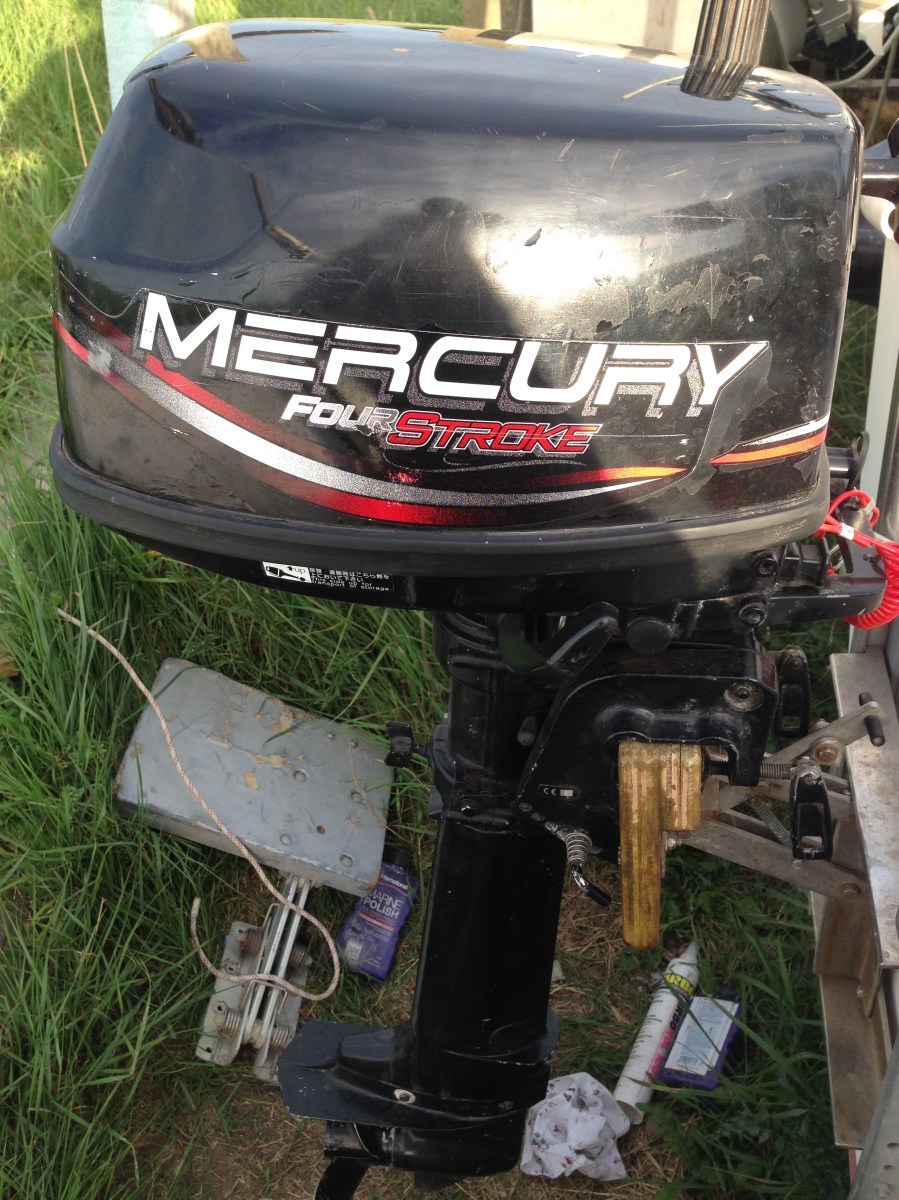
Originally when we first got our boat, it came with a 3 hp Force outboard. That went straight in the shed where it stayed. Maybe useful for when I get a tender. But I did get a Mercury 5hp 4 stroke to start with. I found the economy was great, however, I had to run it like I’d stole it to punch any tide. So the economy was at its lowest for this motor but still great. Upon entering Southwold harbour on a full ebb, the rolling waves would slow the boat and while the mercury would hold me there stationary against the ebb, I was dependent on the next wave to give me that boost I needed. I was also a bit concerned that I was always wide open throttle. It just felt like the motor couldn’t be bothered. So I begun to research other motors.
Yamaha 8hp 2 stroke long shaft
I called our club mechanic who always has something available and asked him what he had. There was a Suzuki 8hp, and a couple of Yamahas. I did some Googling and found that the Yamaha 8hp 2 stroke weighed 27 kg where as the mercury I already had weighed the same. So for me this was a good upgrade as no weight was lost. In fact, there may have been a couple extra kilos as it had an electric start. What a great compromise especially as it could charge the battery too.
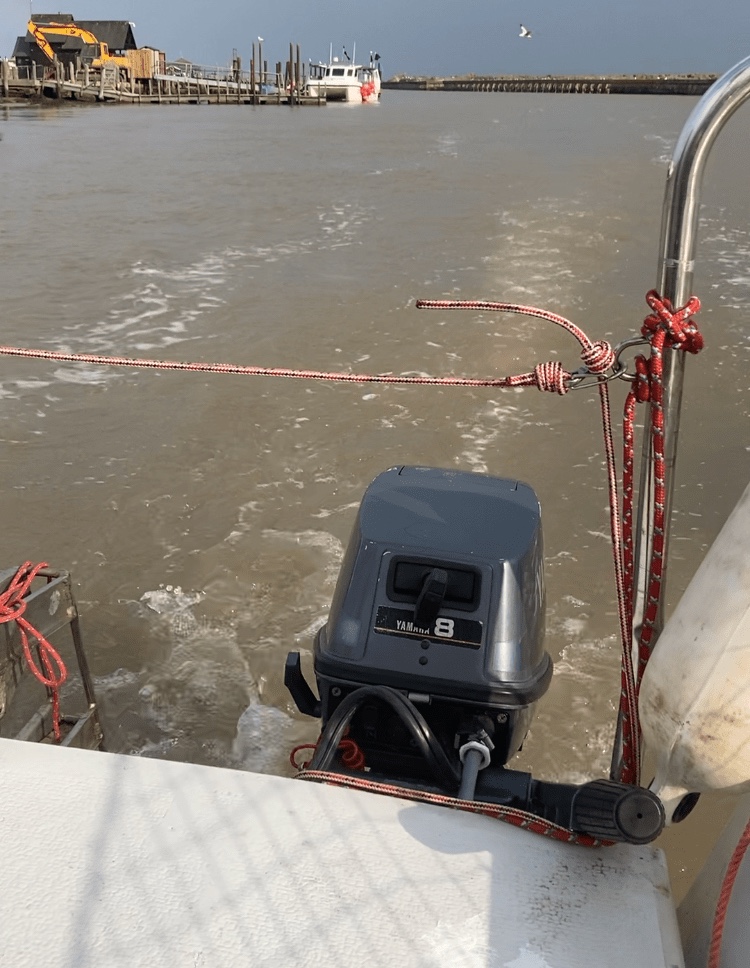
We made the deal in March so I was soon to try it out. The great thing about buying from a mechanic is you get the 1 year warranty, totally worth the peace of mind as if it turns out it’s no good, then nothing is lost. Where as buying one on eBay or marketplace: you will never know what you are gonna get.
Sea trials
As excitement was building I was soon launched and out to sea. I’ve always been a big fan of 2 strokes, I love the sound, the higher revs, and much easier to problem solve. Quite quickly it was clear she had more than enough power for what I needed. This wasn’t a bad thing though.
My first outing I was keen to try it in some unfavourable tide and found that it quite easily got me in the harbour on an ebb tide. The best bit was that I’d reach my maximum hull speed easily at half throttle. If I opened it up to 3/4 throttle, the stern would squat and the bow would start to ride up on its own bow wave. Although the speed didn’t increase when doing this, it had the power to push me through waves and not take ages to build speed up again if a wave was to knock a knot or 2 off. It would soon get back up to speed. I had plenty of power and yet it wasn’t thrashing the motor and thus my fuel economy wasn’t maxing out either. The electric start was just a cherry on cake.
I’ve since punched the full ebb, and flood of the river Deben, Harwich and Southwold and it’s the absolute best combo for motor and vessel. the economy is great, as it’s not running flat out.
To summarise
If you are looking to cruise the east coast, or you operate In strong tidal regions, and you are wondering what outboard motor to get, then based on my experience, an old 2 stroke 8hp long shaft is ideal for a 20 footer. Perhaps a 6hp for a 17/18 footer. But certainly the 8 would be ideal for a 22 footer too.
If you have read this post and now believe that a 2 stroke is for you. There are a couple of other points I’d like to highlight with regarding maintenance and fuel.
It takes a while to build trust in any engine, and the last thing you want is for the motor to conk out when entering a river. Or any time for that matter. It’s unpleasant. Trust me I know. So the motor will only be as reliable as you are at maintaining it. It does go without saying but here are a couple of extra key points.
- The new E10 fuel is rubbish for old motors. I only use super unleaded now- it’s pricier but actually better economy.
- Run your carb dry after use- condensation builds in the carb and when mixes with oil it clogs the emulsifier tube which results in conking out at low revs.
- Keep tools available to do a carb clean. Lighter gas cans are great for blasting the jets.
- Use an external tank, I use a 12 litre tank. I keep a section of fuel hose with a primer bulb to suck out the last bit of fuel before refilling. This keeps your fuel tank clean. Peace of mind.
- Always have a device to unblock the tell tail at hand. Even though the engine may still be cooling if the tell tail isn’t working, it may also not be cooling. Yamahas have quite a small tell tail hole, it clogs easily.
And that’s it. I guess the only other thing I’d add, is that Tohatsu, Mariner, Suzuki, Mercury and Yamaha all do really good 2 stroke motors. I’d expect to pay £800 for a decent 8 hp. Or a 6hp. I think they may even be the same weight too. So may as well go for the 8. But whatever your choice of outboard may be, I wish you all the very best for your passages on the east coast and beyond.
Ollie-Boated out!
Thanks for reading this post, I really hope you found it useful. If you have any questions, or would like to share your set up, please do get in touch. I’d love to hear from you. If you’d like to check out my write up of sailing to Woodbridge just before Christmas when it was super icy, we had a 25Nm downwind sail hitting over 10knots time and time again! You can find it here.
Enjoyed This Read?
BOATED OUT is entirely self-funded. If you’d like to help keep the videos coming, here’s how – no pressure at all.


Got to agree with your choice. I’ve got a Leisure 23sl with an 8hp yamaha 4 stroke it weighs about 47 kilos. Even trying to lift it up on the outboard bracket with spring assist is a problem for me now at nearly 70. I have rigged 2:1 purchase tackle to my backstay just to lift it to its up position. It is nice to have enough power though. ….. Greetings from Queenborough, River Medway/Swale.
LikeLike
Hi Richard, thanks for your comment, good to hear from a fellow sailer. That’s crazy 20kgs difference between 2 and 4 stroke. But at least you have the power you need hopefully. Sounds like you’ve got a good system, that would be a handy feature even with a smaller motor. Thanks for that tip. Fair winds to you and your leisure 23 from Sunny Southwold! 😁⛵️
LikeLike
Interesting reading
LikeLiked by 1 person
Thanks Jane⛵️
LikeLike